
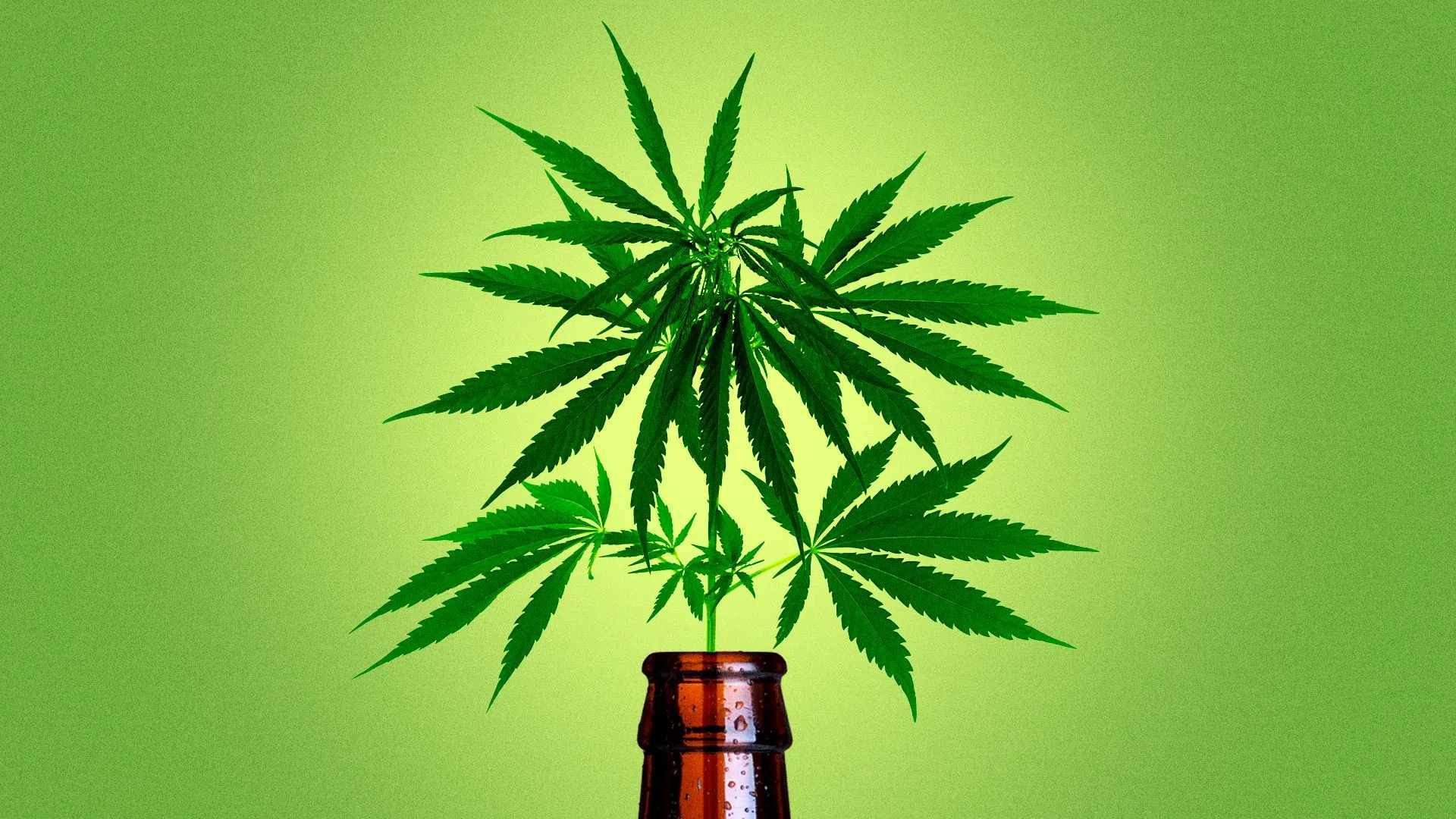
When Cannabis Steps Into the Bar: What New Research Says About Cross-Fading and Drinking Less
Every seasoned THC drinker has heard the age-old question: “What happens when you mix alcohol and cannabis?” But until recently, almost nobody studied that question in a controlled setting — no party stories, no “I swear this works,” no guessing. Just actual data.

A new study out of Brown University finally puts numbers behind something many consumers have long noticed: after using cannabis, a lot of people don’t feel like drinking as much.
Researchers brought 157 adults — all regular cannabis and alcohol users — into a controlled “lab bar” decorated with Guinness signs and string lights to mimic the real thing. Participants showed up for three separate sessions: one with high-THC cannabis, one with low-THC cannabis, and one with a placebo joint. To keep things clean and measurable, everyone followed a standardized pacing routine (“inhale now… exhale now…”), so dosing wasn’t left to chance.
After smoking, participants headed to the mock bar stocked with their drink of choice. What scientists saw from behind the two-way mirror wasn’t subtle:
- Those who smoked high-THC cannabis drank roughly one-third less than during the placebo session.
- Those who smoked low-THC cannabis drank about 20% less.
The takeaway wasn’t that cannabis magically cures drinking — the researchers were careful to say we’re nowhere near making claims like that. But the pattern was consistent: in this controlled space, cannabis made people less inclined to reach for another drink.
That fits the cultural moment. The rise of “California sober” — swapping alcohol for cannabis or other non-boozy options — isn’t just a vibe shift. It’s tied to the wider availability of cannabis products (including modern THC beverages), growing awareness around alcohol’s health costs, and shifting consumer preferences. This study suggests the trend may also have a behavioral foundation.
Still, the scientists emphasized limits. The cannabis used in the trial was less potent than most commercial products on the market, and real-life environments aren’t controlled labs. Plus, the relationship between THC and alcohol is far from simple — potency, format (smoking vs. drinking vs. edibles), timing, and personal tolerance all matter.
What this study really shows is how much we still don’t know about cross-fading. Alcohol and cannabis are often used together in the real world, but historically studied in isolation. As stronger cannabis products — and new formats like THC beverages — become mainstream, building a clearer understanding of how these substances interact is only becoming more important.
For now, this research gives us something valuable: early, rigorous evidence that cannabis can reduce the desire to drink, at least in a controlled environment. It’s not a conclusion — it’s a direction. And it marks one more sign that the conversation around alcohol, cannabis, and mindful consumption is evolving fast.
Reference Links
- Co-use of Alcohol and Cannabis: A Review — This review looks at the behavioral, health, and social consequences of alcohol + cannabis co-use. PMC
https://pmc.ncbi.nlm.nih.gov/articles/PMC7363401/ - The effects of simultaneous alcohol and cannabis use on performance and risk behaviors — A 2024 paper reviewing outcomes for people who combine alcohol and cannabis. PMC
https://pmc.ncbi.nlm.nih.gov/articles/PMC11238947/ - Coverage of the recent controlled study on cannabis & drinking — “Smoking marijuana shown to weed out thirst for alcohol,” summarizing the lab-based drinking + cannabis experiment. Marijuana Moment+2therumlab.com+2
https://www.marijuanamoment.net/people-drink-significantly-less-alcohol-after-smoking-marijuana-federally-funded-study-shows/